Citation
Hess, Jillian. “P.S. Emerson’s Tips for Finding Notes.” Substack newsletter. Noted, 3 Oct. 2024, https://jillianhess.substack.com/p/ps-emersons-tips-for-finding-notes.
Quotes
- species:
- themes:
Collations
to find what is in one’s notebooks, one must be in constant contact with them—regularly re-reading and indexing entries. This takes time and dedication.
Early on, he adopted Locke’s indexing system, but he quickly abandoned it in favor of a simpler, chronological index at the back of his notebooks.
as his notes accumulated, he embarked on an astoundingly extensive indexing system.
notebooks full of references to other notebooks, including the 400 page “Index Major.”
Early on, Emerson appreciated the value of an index. He began to label his pages with topics that guided him as he wrote essays as a student.
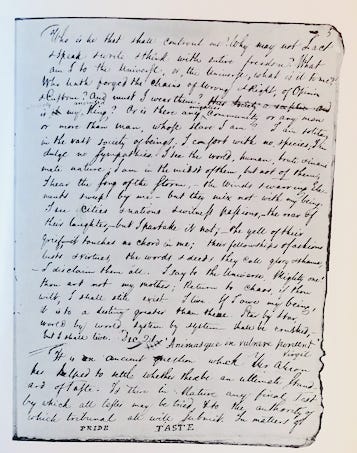
Emerson’s topics at the bottom of the page in “Wide World” 12, The Journals and Miscellaneous Notebooks of Ralph Waldo Emerson, I
But topics took on more significance as Emerson’s journals accumulated, his career advanced, and he toured the country giving his popular lectures.
Emerson would prepare for his lectures by reading through his commonplace books—finding a topic that had been “growing on his mind for some time.” Once he located a theme, Emerson searched through his notebooks for quotations.
He finds what he has in his commonplace book; looks over it and sees what passages he has written, perhaps during the last twenty or forty years…
Emerson took notes constantly—when he left home he carried pocket notebooks.
When he read, he immediately transferred quotes and reflections into his commonplace books.
Accumulating such a rich source of information was one of Emerson’s talents, but another talent was figuring out how to categorize information.
Before Emerson announced a new lecture series, he began the sifting process, picking strains of thought that had preoccupied him. He designated topics with corresponding journal entries.
Here, Emerson lists the following themes along with corresponding notebooks (designated by alphabetic letters) and page numbers:
Reform
Obligation to the Reformers D 337
Reform in housekeeping D 342
The problem how to spend a day nobly D 350 E 24
Manual Labor D 304, 313, 328, 137
The garden discovery D 300
Damper of reform D 306
List of reforms D 309
Reform must not be partial D 328
As Emerson got deeper into a project, he started creating indexes of short phrases
“The Poet”:
Poetry is “wanton heed & giddy cunning.”
Real words good as real actions E 226
all poems unfinished H 112
Music first before thought. F.55
Every word a trope G 43, 57, 60.
Power to affect me in natural objects impersonal & unrepenting. H 45
Every promise many fulfil[l]ments. F 112
the connection between Emerson’s indexes made of key phrases and his signature aphoristic style. It makes sense that the act of indexing—of distilling thought to its essential components would lead to aphoristic writing.
as you think of how you’d like your index to look, you might be better off working backwards. What is it you hope your notes will accomplish? What kind of writing style will you employ? What kind of index entries will best serve your goals?
Note-taking and writing style create a feedback loop: Emerson once remarked that he felt more like a scribe than a poet—but the practice of distilling his ideas and indexing them clearly helped him clarify his thoughts and develop his signature style.
before you begin indexing your notebooks, it might be worth thinking through how you hope to use your index—if it is for writing projects, you might consider how the way you write your index will seep into your written style.
One index might not be enough: Emerson created individual indexes for his notebooks as well as several master indexes—100s of pages long.
The act of indexing is creative sorcery: Through indexing, we create connections and themes. It helps us think through information.
pulling disparate quotes and ideas together will, hopefully, reveal your own interests and obsessions and reveal new paths for your own projects.